About things that must be eaten

Each of our excursions to foreign soil invariably comes with a list of all the things that must be seen, and in our case, that must be eaten as well!  Food is forever entwined in our travel experiences and it just adds another dimension to our memories.

There are many things that have featured on our obligatory “must consume” lists and to pick just a few is akin to torture.  Actually, come to think of it I know this is not going to be the last you hear of this…!  But taking that first bite step always helps…

Pissaladière

This lovely ‘pizza’ has its origins in Nice, in the south of France.  The base is slightly ticker than that of a pizza and it is topped with caramelised onions, anchovies and olives.  I always wanted to taste it, but could never quite imagine what the flavour would be like.  I waited until we reached the beautiful little city of Narbonne and scoffed my first slice in Les Halles de Narbonne.  It was amazing!  I never knew onions could be so sweet.  The salty anchovies and bitter olives beautifully complements the almost jam-like onions. YUM!  After that holiday, it was the first thing we made when we were back home!

Beef tartare

This is another one that I wanted to try in France.  This is probably not to everyone’s’ taste.   It is a meat dish made from finely chopped raw beef, served with onions and capers, with a raw egg yolk to top it off.  Coincidently, I also had this in Narbonne, in a little restaurant opposite the market.  I awaited my order with trepidation.  I do eat beef carpaccio and have my steaks medium rare, but I was not sure just how my body would react.  Turns out, my body loves it!  You can really taste the flavour of the meat if you have it in this way.  And the egg yolk (which was probably what I was most afraid of!) just melts away in the background and just gives a silky taste to the dish.  Loved it!

Scotch egg

Perhaps not as sophisticated as a beef tartare, but I really wanted to try this British speciality.  A scotch egg is made up from a hard-boiled egg, around which a layer of sausage meat is formed into a ball shape.  The ball is then coated in bread crumbs and deep fried.  After a morning exploring London, we stopped over at Borough Market, where stalls are spread out under high railway lines.  We ordered our scotch egg with some sweet potato fries and plonked down on the grass next to Southwark Cathedral.  The scotch egg tastes exactly as you think it would; egg and sausage with a crispy crumb.  But if you are tired after walking about the whole morning, just the thing to give you energy for the next stretch.

Roasted chestnuts

This was not something on our must have list as, to be honest.  However, when we arrived in Paris we saw men pushing shopping trolleys around, containing a drum, in which they seemingly made fire, topped with a large round disk.  On top, warming up, was snails… or what looked like snails from afar… if you use your imagination.  (Or maybe we were just really tired from our journey there!)  Eventually we realised that we were actually looking at chestnuts roasting.  It has a lovely buttery taste with a touch of smoke from the fire; the perfect snack for a blustery, chilly day in Paris.

Vlaamse frites

I suppose frites (chips) is chips is chips.  But in Amsterdam you get them with so many sauces!  My heading should probably be “Sauce in Amsterdam, with frites”.  (As if anyone really needs an excuse to eat more starch.  Sigh) There is the lovely thick mayonnaise which is always a winner, and I also enjoy mixing some tomato sauce with mayonnaise.  Tartar sauce, chilli sauce, garlic mayonnaise… but my favourite is the stoofvlees (stewed meat) sauce.  Delicious!  Also, Amsterdam was a real explosion of people, sights and sounds to me…  I have not seen anything like it.  So it was better to constantly walk around nibbling a chip or two for fear that my mouth would just hang open in wonderment all the time.

Champagne

The first time we went to France we took a day-trip from Paris to the Champagne region.  We visited Épernay, home to Moët & Chandon and Reims, home to G. H. Mumm & Cie.  The cellar tours were amazing; seemingly endless tunnels under ground filled with bottles and bottles of sparkly goodness.  The history and the craft… really special.  We were lucky enough to do champagne tasting at both these wonderful producers (because let’s face it, this is not something I can afford to buy everyday… or even every year) so to say that I sipped on champagne in Champagne is definitely a highlight.

… to be continued … until we eat again!


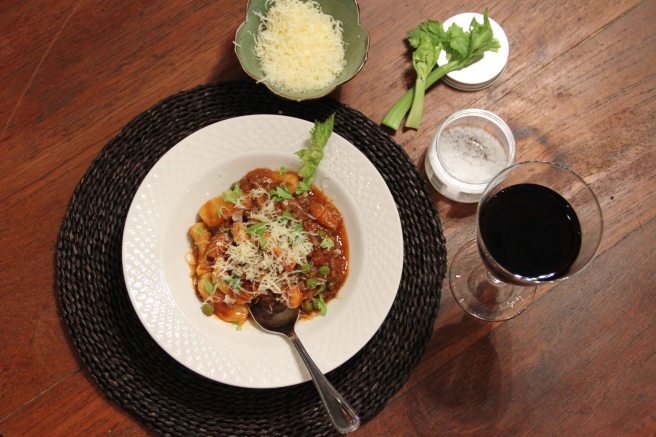
Lamb shank ragu with homemade cavatelli pasta

IMG_0854
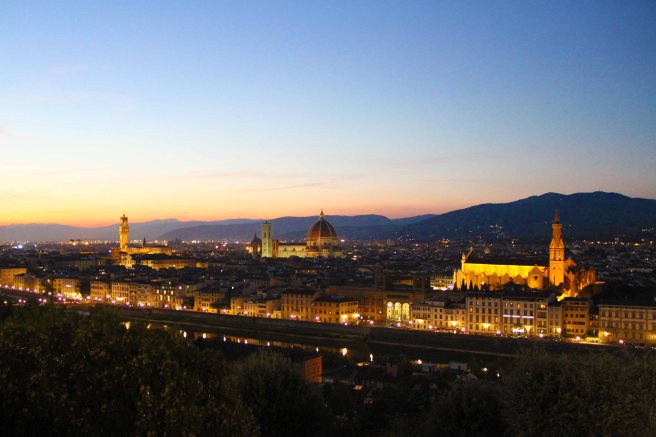
Florence and the Tuscan hills at twilight

Italy was nothing like I thought it would be.   I thought I would really be keen on the history, the culture, the food, the wine… but I was wrong.  I didn’t like it.  No.  Instead I fell completely and utterly in love with each and every aspect of this incredible country.  From the breath-taking beauty of Venice to the magical Amalfi coast, with incredible Tuscany in between.

We spent our time in Tuscany using Florence as a base.  It was so much more than I expected!  It is a city of art, culture, great food and music.  Everywhere we went we were greeted with a tune; from street performers playing as twilight fell, while we marvelled at the Tuscan hills twinkling with lights and while famous Renaissance landmarks stood silhouetted in the foreground gazing out from Piazzale Michelangelo, to being caught up in marching bands walking down the street towards the marvellous Piazza della Signoria and its line-up of sculptures.  Life had a soundtrack when we were there!  Florence is really a place I think I could call home.  Sitting next to the beautiful Arno River, watching row boats go by, sipping aperol (without pulling a face), life felt pretty good.  (OK, if you’ve been following my blog you would know aperol is not a personal favourite… but as they say – when in Rome… or Florence!)

On one of the days we explored the Tuscan country side, we stopped for lunch at a farm called Fattoria Poggio Alloro.  It is just outside San Gimignano where you can find twelve beautifully preserved medieval towers (in its day it had seventy!). The farm produce and sell everything from olive oil, pasta, cured meats and of course, glorious wine!  Hubby and I first did a cellar tour before we sat down to an amazing lunch.  The setting was really what Italian dreams are made of, with spectacular views over the Tuscan country side and the towers of San Gimignano looming on the horizon.

Lunch consisted of lovely fresh breads with some prosciutto, salami, olive oil and balsamic vinegar.  Main course was the kind of Italian pasta you hope to have on a visit to Tuscany, served with a rich, delicious meat ragu and a side salad.  And don’t forget the wines!  We ended off with a sweet dessert wine.  Simply put – it was a foodie’s heaven.

So tonight, while weather is cooling down here in Cape Town and light rain falls outside, hubby and I thought we would pay homage to this wonderful meal we had.  Definitely a good way to start the weekend.

Lamb shank ragu with homemade cavatelli pasta

(serves 4)

IMG_3314

First get started on your lamb ragu.  While that cooks away, you can start on your homemade pasta.

We use a pressure cooker to cook the lamb shank quickly.  If you don’t have a pressure cooker you should aim to cook your meat for about 2 hours to ensure it is nice and soft.

Lamb shank ragu

Ingredients:

2 tablespoons of olive oil

500g lamb shank

1 large onion, finely chopped

2 garlic cloves, crushed

4 medium carrots, peeled, and sliced diagonally

2 celery stalks, chopped

½ cup of frozen peas

Bunch of rosemary and thyme (tie it up, so you can take it out easier at the end)

1 cup of good red wine

1 tablespoon of Worcestershire sauce

1 cup of water

1 teaspoon of sugar

2 tablespoons tomato puree

400g tin of diced tomatoes

1 chicken stock cube

Salt and Pepper to taste

Method:

  1. Heat the olive oil in a pressure cooker over medium heat. Add the lamb shank and fry until brown on all sides.
  2. Add the onions and fry until golden brown. Add the garlic and stir for a minute longer.
  3. Add the carrots and celery and fry for another 2 minutes until the vegetables start to soften.
  4. Add the cup of red wine and let the alcohol cook down.
  5. Add the tin of chopped tomatoes, tomato puree, Worcestershire sauce, and the cup of water.
  6. Next, add the sugar, stock cube and season with salt and pepper.
  7. Now add your bunch of herbs and close the pressure cooker.
  8. Cook on medium heat for an hour. Now get on with your homemade pasta – see the recipe and method further down…
  1. After an hour, remove the lamb shank from the pressure cooker. Discard the bunch of herbs.
  2. Shred the meat off the bone – it should be soft and very tender. Discard the bone and any fatty pieces.
  3. Reduce the sauce in the pressure cooker pot (lid off) until it has thickened.
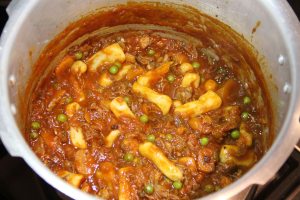
  4. Add the peas to the sauce and return the meat to the pot.
  5. Simmer at low heat, while you boil your pasta

Homemade cavatelli pasta

Ingredients:

500g of “00” flour

Pinch of salt

1 tablespoon olive oil

1 ¼ cups of cold water

Method:

  1. Place the flour in a large bowl. Make a little well in the center.  Add the salt, oil and water and mix with a fork until a dough is formed.  (It works best to get it together in a bowl and then turn it out on your counter and work into a firm ball.)
  2. Divide the dough into small pieces and roll it on your countertop to form a “sausage”/rope that is about 1cm thick. Start by working your hands from the inside to the outside to try and keep the shape as even as possible.
  3. Using a knife, slice the dough into about 2 to 3 cm pieces.
  4. Next, shape the cavatelli with your thumb. Put the piece of dough on the counter and push the dough against the countertop away from you so that the dough stretches slightly and folds around itself, creating a little pocket in the middle.
  5. Place the cavatelli on a lightly floured baking tray (do not let them touch) and let it rest for 40 minutes.
  6. Bring a pot of salted water to the boil. Toss the cavatelli in and cook until it floats to the top and stays there.  It takes approximately 3 – 8 minutes, depending on the size of your pasta.
  7. Transfer the pasta to a strainer and drain.

Lastly, add your drained pasta to the ragu and let it simmer for 10 minutes to absorb all the lovely flavours of your ragu.

IMG_3313
Add your pasta to your ragu

Serve with some grated parmesan.

Fantastico!

IMG_3316

About beer and truffles

IMG_8602
How many bottles of beer on the wall?

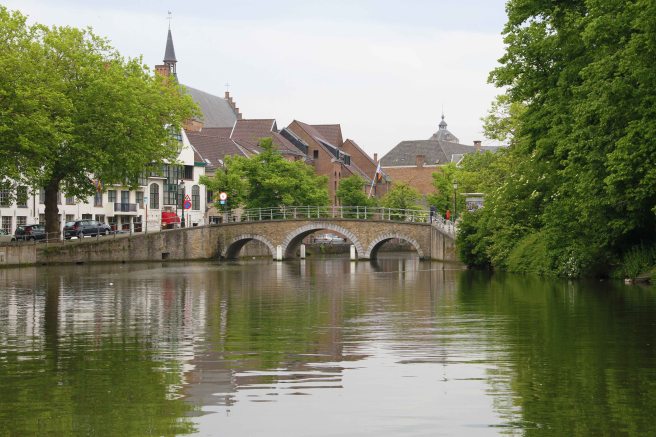
With Valentines Day approaching I can’t help but think that if men are from Mars and women from Venus, the perfect place to reunite them would be beautiful Bruges in Belgium.

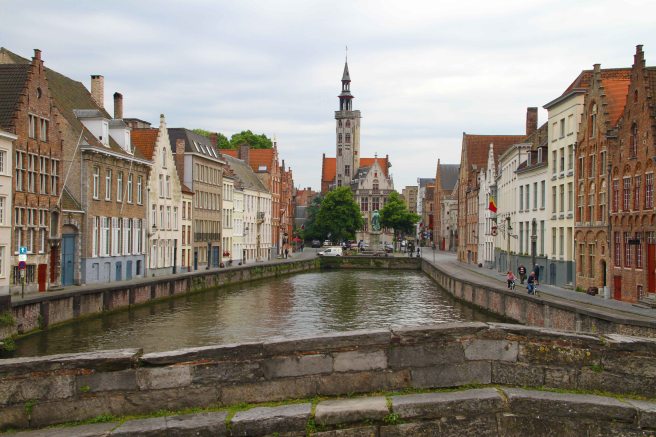
Bruges is often referred to as the “Venice of the North” and with its historic city centre, its jaw-dropping architecture and the canals curling around its beautiful old buildings and narrow streets it is not hard to imagine that you could fall in love here.  It really is an amazing city that had me under its spell from the moment we arrived.

IMG_8198

However, it is actually not its perfect postcard prettiness that leads me to believe that this is the perfect place to reunite the sexes.

No, what makes this the perfect common ground is the two things Bruges have aplenty… beer and chocolate!

Belgium is renowned for its beer so it is no wonder that the average beer drinker downs about 81 litres of beer a year.  And when upon arrival at our lovely guesthouse in Bruges at 11:00 in the morning our lovely hostess immediately brought out some complementary beers, it became clear just how easily a person could reach that level of consumption!

I won’t pretend to be a beer connoisseur.  (I have to admit, to me it tastes like sucking on some hay bales, but to each his own!)  Having said that, it was fascinating to see just how many different types of beers you get and now and then I could even taste the odd one that I could swallow without pulling a face!  Typically the Belgian beers are served in bottles and not cans, but what makes it even more special is that each type of beer has its own distinct glass in which it has to be served! According to those in the know, using the right glass for the beer actually improves its flavour.  (Maybe that’s what’s wrong –  I’ve been using the wrong glass all along!)

We were lucky enough to discover the famous ‘t Brugs Beertje beerhouse.  It is located between the Markt and the Zand in 5 Kemelstraat.  It is off a small side street of Steenstraat – look carefully, or you might miss it. Here you can find over 300 different Belgian beers!  It is a unique little pub, with all kinds of beer paraphernalia on the wall.  Tables are close together and quickly someone that you don’t know can become an acquaintance in the search for the best beer on offer!

Hubby’s favourite was the Brugse Zot, which is actually a beer produced by De Halve Maan brewery right there in the historical town centre of Bruges.  It is a blond beer and hubby tells me it really tasted great; apparently fruity and not too bitter.  He also tried the Straffe Hendrik Quadruple (you can translate that to “Strong” Hendrik).  And boy, it is strong!  It has an 11% alcohol content!  (And tastes like many, many bitter hay bales!)

However, hubby’s ultimate favourite beer we found in a small pub in Damme.  Damme is only about 10 kilometres from Bruges and we cycled there one afternoon along the canals.  It was a superb experience; a bit misty but so beautiful cycling in such beautiful country side!   We found the pub on a corner on the main road.  He tried a few beers there as well, but when he put his lips to his first Leffe Blond, I had to accept that it would seem that in the world of beer, he thought blonds was more fun!

But don’t feel sorry for me and all the times I had to endure the bitter taste of the best Belgium had to offer.  Oh no… because with bitter there is always sweet.  You see, while our wonderful hostess brought out the beers early, she also brought out the chocolates for later!

As much beer as you can find in Bruges, that’s how much chocolate you can find.  There are beautiful little chocolate shops all over town; some just selling their chocolates in the front of the shop in a display that dazzles and others where the master chocolatiers display their skill right in the middle of the store for all to see.

I was amazed by the little figurines – sheep, bees, soccer balls, ducks, angry birds (!) and yip, even little chocolate beer bottles!  These were way too pretty to eat and I could only bring myself to take pictures of them!

IMG_8215


But oh, the pralines!  Little chocolate shells with soft-centred fillings of heavenly delight!  I love any type of strawberry fillings.  Orange fillings.  And salted caramel.  And coffee.  Oh, and cherry!  I love them all!  And mint!

But don’t forget the truffles!  A little bit of bitter cocoa powder around a soft ganache.  So soft that you just have to eat them quickly otherwise they will melt!  My favourites have a bit of nut mixed in the ganache.  And the best time to have them is after dinner… and before dinner… really any time the craving strikes!

There was this little shop we passed by each day we we walked back to our guesthouse.  We would walk in and just order a random selection of truffles and pralines and it was such a treat to pick through the box not knowing what you were going to get next!  Our guesthouse had this lovely gazebo and we spent all our evenings sitting out there with some wine (for me), some beer for hubby and some chocolate!

So you see, Bruges provides the perfect setting to bridge the gender gap!  It’s a beautiful and romantic setting that brings together bitter sweet in perfect harmony!  Let there be love!

IMG_8164

Aubergine á la Avignon

IMG_2154

Food is such a big part of our lives.  Just about everything has a food angle to it!

“It’s our anniversary, where are we going to go for supper?”  “Saturday looks like it is going to be a great day for the beach – shall we pack a nice picnic basket?”  “The in-laws are coming over for Sunday lunch – what new dessert recipe can we try?”  “Let’s watch some videos of our trip to France; then we make some Frenchy foods.”

Benjamin Franklin said “Eat to live, don’t live to eat.”  Well, thank goodness then that I need to eat to live, because I really like living, which means I can really like eating!

We have never returned from our travels with bad food memories (apart from one really bad pizza we had in Rome; think the restaurant was too close to a drain because the smells were awful!).  There are always things that we’ve tasted on our journeys that we try and replicate at home.  A recent favourite is from our trip to Provence a few months ago.

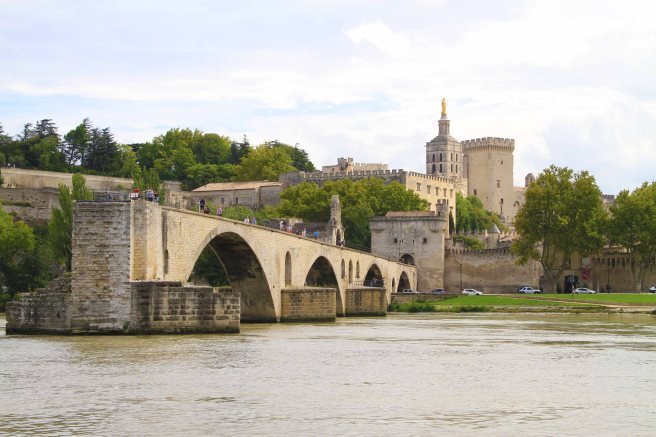
Avignon was our base.  On the must-do list was a picnic on the Ile de Barthalese with its iconic view over Pont Saint-Bénézet and the Palais des Papes.  We decided to stop over at Les Halles to pick up some substance for our al fresco lunch.  Walking around, the “Aubergines á l’ Italionne” caught my eye.  (I love aubergine – a love that only developed a few years ago.  I blame it on all the badly cooked aubergines I’ve had in my life up until that point!)  It looked so good and smelt divine and when one of the local residents standing in line in front of us chose this for her lunch, the deal was done.  What more do you need than the local stamp of approval?!

IMG_2225
Who would not want to have a picnic if you can have such a view?!

Back at home, in the absence of a recipe, hubby and I only had our taste buds and memory to go on when we tried to recreate the dish.  Here is to encouraging a few more aubergine converts with our version.

Aubergine á la Avignon

(serves 4)

Ingredients:

1 large aubergine

4 tablespoons butter

4 tablespoons olive oil

1 large onion, chopped finely

1 teaspoon garlic, chopped finely

400g beef mince

1 tin chopped tomatoes

1 ½ teaspoons tomato puree

2 cups water

1 ½  teaspoons of sugar

1 teaspoon of dried Provençal herbs (oregano, thyme, rosemary and basil)

Salt & Pepper to taste

125g mozzarella cheese, grated

Method:

  1. Cut the aubergine lengthways in 1cm thick slices. Keep the skin on.  You need four slices.
  2. Remove the skin of the remainder of the aubergine. Chop into small cubes.
  3. Heat two tablespoons of butter and a tablespoon of olive oil in a pan. Fry two slices of aubergine until soft, turning regularly to ensure a nice brown colour on both sides.
  4. Transfer the aubergines to a baking tray.
  5. Repeat steps 3 and 4 with the remaining two slices of aubergine. (Aubergines love butter so it is better to do them two at a time to ensure each gets enough to keep them soft and get that nice and golden colour.)
  6. Heat a table spoon of olive oil in a pan. Add the chopped aubergine, onions and garlic.
  7. Fry until golden brown and soft.
  8. Remove the aubergine, onion and garlic from the pan and set aside.
  9. Heat a tablespoon of olive oil in the pan and add the mince. Fry until brown.  This really adds to the flavour.
  10. Once the mince is brown, add the chopped aubergine, onions and garlic back in.
  11. Add the chopped tomatoes, tomato puree, two cups of water, sugar, herbs and salt and pepper.
  12. At this stage, pre-heat the oven (on the grill setting) to 180°C
  13. Let the mince mixture boil until the sauce is reduced completely.
  14. Once done, place some mince on top of each aubergine.
  15. Top it off with grated mozzarella.
  16. Bake in the oven for 10 minutes, until the cheese has melted.
  17. Serve with a salad.

IMG_3274

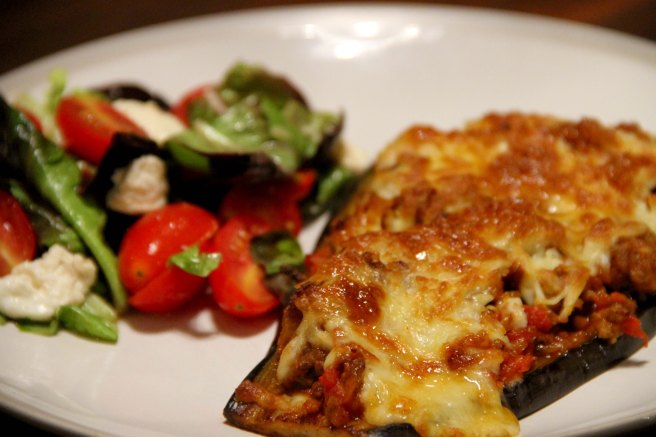
Voilà! Aubergine á la Avignon