Sundays have never been a particular favourite day of mine. I think it stems from when I was small. After Sunday lunch my thoughts always turn to the inevitability of Monday morning and back to school; and when at seven pm the theme song to my parents’ favourite wildlife program would ring out on the telly, I knew with certainty – the weekend was over.
I’ve carried a bit of that into my adult life and I will lie if I say that the same case of Sunday blues don’t still affect me some days. However, being grown-up has other perks (apart from no homework!) which makes Sundays a whole lot more bearable. There’s the Sunday morning lie in, coffee in bed, sometimes a late brunch (with some bubbles of course!)… or like today, the anticipation of a wonderfully lazy lunch at home, trying out a new recipe I found in a magazine.
There is something about making slow food, without a rush, that is good for the soul. I think it might be because it helps you to focus in the present; be it getting your hands a bit dirty, the aromatic smells, practicing your chopping skills or sipping a glass of your favourite wine – there is no worries beyond creating a wonderful meal and definitely no thoughts of Monday looming!
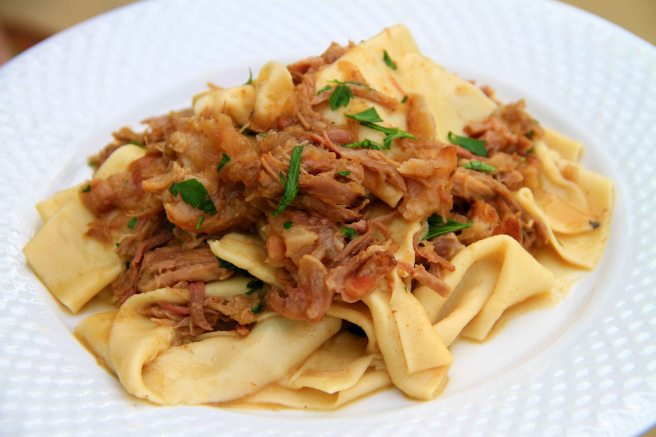
So today this lunch of homemade pappardelle pasta and pulled pork is just the thing to make the weekend last that little bit longer. And if I am lucky there might be some leftovers for … let’s rather not say it!
Homemade pappardelle with pulled pork
(serves 4)
Ingredients:
For the pork:
2 tablespoons olive oil
1 garlic clove, chopped finely
2 tablespoons of apricot jam
1 kilogram pork shoulder
1 onion, finely chopped
3 apples, peeled, cored and cut in quarters
2 pears, peeled, cored and cut in quarters
250ml vegetable stock
250ml cider
For the pasta:
400g flour
Salt
4 eggs
2 tablespoons of butter, melted
Handful of chopped flat leaf parsley, chopped
Method:
Pork:
Preheat your oven to 180 degrees Celsius
Rub the pork with the apricot jam and garlic.
Heat the olive oil in a large pan and brown pork on all sides. Remove the pork from the pan, place in an ovenproof dish and set aside.
Add the chopped onions, apples and pears to the pan and fry until caramelized.
Place the onions, apples and pears with the pork in the ovenproof dish and add the stock and the cider.
Cover with a lid (or foil) and roast in the oven for 1.5 hours or until the meat can be pulled apart easily.
Shred the meat in the dish.
Brown pork on both sides
Fry apples, pears and onions until caramalized
Add the apples, pears and onions to the pork shoulder and pour over the cider and vegetable stock
Pasta:
Place the flour into a large mixing bowl.
Add a pinch of salt and make a well in the centre of the flour.
Add the eggs to the centre of the well and mix until a dough forms.
Turn the dough out on a lightly floured surface and knead it until elastic. Cover in clingfilm and lest it rest for 30 minutes.
Flatten the pasta dough out with your rolling pin and then roll it out to about 3mm thick. (You can use a pasta machine if you don’t have the arms for it!)
Cut it into about 5cm wide strips and cook in boiling salted water until al dente. Drain off the water.
Make a well in the middle of the flour and add the eggs
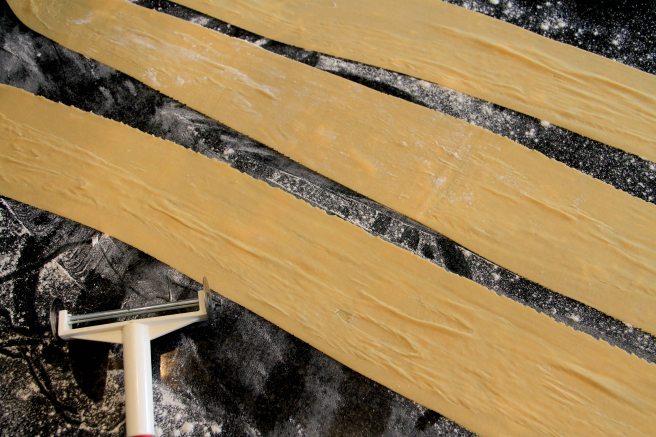
After resting the dough, roll out in 3mm strips
Cut the pasta to pappardelle
To serve, toss the hot pappardelle with the melted butter. Add the pulled pork and gently mix through. Top off with the chopped parsley.
Italy was nothing like I thought it would be. I thought I would really be keen on the history, the culture, the food, the wine… but I was wrong. I didn’t like it. No. Instead I fell completely and utterly in love with each and every aspect of this incredible country. From the breath-taking beauty of Venice to the magical Amalfi coast, with incredible Tuscany in between.
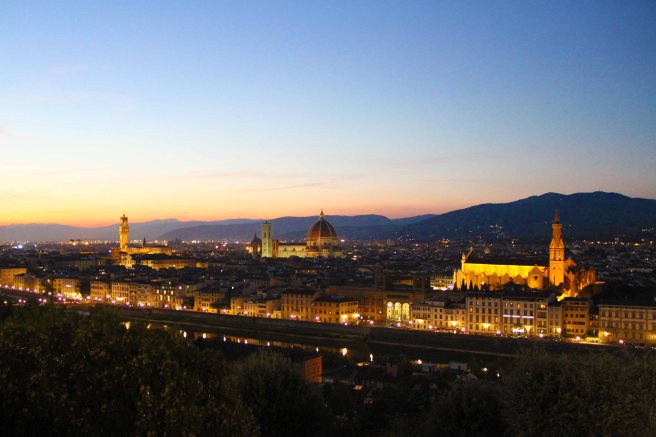
We spent our time in Tuscany using Florence as a base. It was so much more than I expected! It is a city of art, culture, great food and music. Everywhere we went we were greeted with a tune; from street performers playing as twilight fell, while we marvelled at the Tuscan hills twinkling with lights and while famous Renaissance landmarks stood silhouetted in the foreground gazing out from Piazzale Michelangelo, to being caught up in marching bands walking down the street towards the marvellous Piazza della Signoria and its line-up of sculptures. Life had a soundtrack when we were there! Florence is really a place I think I could call home. Sitting next to the beautiful Arno River, watching row boats go by, sipping aperol (without pulling a face), life felt pretty good. (OK, if you’ve been following my blog you would know aperol is not a personal favourite… but as they say – when in Rome… or Florence!)
Lovely farm
Great food, great views
On one of the days we explored the Tuscan country side, we stopped for lunch at a farm called Fattoria Poggio Alloro. It is just outside San Gimignano where you can find twelve beautifully preserved medieval towers (in its day it had seventy!). The farm produce and sell everything from olive oil, pasta, cured meats and of course, glorious wine! Hubby and I first did a cellar tour before we sat down to an amazing lunch. The setting was really what Italian dreams are made of, with spectacular views over the Tuscan country side and the towers of San Gimignano looming on the horizon.
Beautiful Tuscan landscape
San Gimignano in the background
Lunch consisted of lovely fresh breads with some prosciutto, salami, olive oil and balsamic vinegar. Main course was the kind of Italian pasta you hope to have on a visit to Tuscany, served with a rich, delicious meat ragu and a side salad. And don’t forget the wines! We ended off with a sweet dessert wine. Simply put – it was a foodie’s heaven.
So tonight, while weather is cooling down here in Cape Town and light rain falls outside, hubby and I thought we would pay homage to this wonderful meal we had. Definitely a good way to start the weekend.
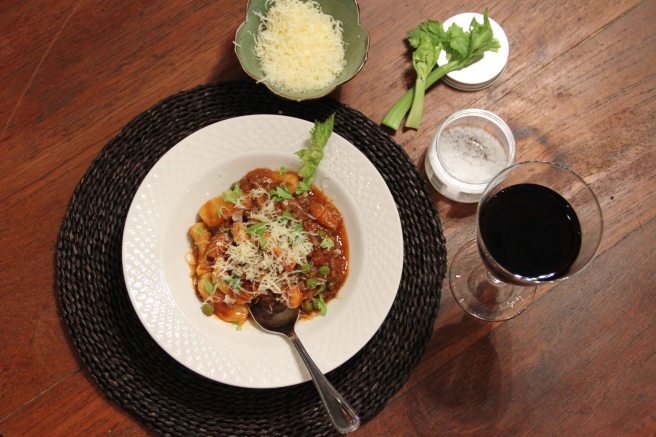
Lamb shank ragu with homemade cavatelli pasta
(serves 4)
First get started on your lamb ragu. While that cooks away, you can start on your homemade pasta.
We use a pressure cooker to cook the lamb shank quickly. If you don’t have a pressure cooker you should aim to cook your meat for about 2 hours to ensure it is nice and soft.
Lamb shank ragu
Ingredients:
2 tablespoons of olive oil
500g lamb shank
1 large onion, finely chopped
2 garlic cloves, crushed
4 medium carrots, peeled, and sliced diagonally
2 celery stalks, chopped
½ cup of frozen peas
Bunch of rosemary and thyme (tie it up, so you can take it out easier at the end)
1 cup of good red wine
1 tablespoon of Worcestershire sauce
1 cup of water
1 teaspoon of sugar
2 tablespoons tomato puree
400g tin of diced tomatoes
1 chicken stock cube
Salt and Pepper to taste
Method:
Heat the olive oil in a pressure cooker over medium heat. Add the lamb shank and fry until brown on all sides.
Add the onions and fry until golden brown. Add the garlic and stir for a minute longer.
Add the carrots and celery and fry for another 2 minutes until the vegetables start to soften.
Add the cup of red wine and let the alcohol cook down.
Add the tin of chopped tomatoes, tomato puree, Worcestershire sauce, and the cup of water.
Next, add the sugar, stock cube and season with salt and pepper.
Now add your bunch of herbs and close the pressure cooker.
Cook on medium heat for an hour. Now get on with your homemade pasta – see the recipe and method further down…
After an hour, remove the lamb shank from the pressure cooker. Discard the bunch of herbs.
Shred the meat off the bone – it should be soft and very tender. Discard the bone and any fatty pieces.
Reduce the sauce in the pressure cooker pot (lid off) until it has thickened.
Add the peas to the sauce and return the meat to the pot.
Simmer at low heat, while you boil your pasta
Fry lamb shank until brown and veggies until soft
Add wine and cook down
Add rest of liquids and add herbs. Cook for an hour.
Remove from pressure cooker.
Shred the meet fine.
Reduce the sauce in the pot.
Homemade cavatelli pasta
Ingredients:
500g of “00” flour
Pinch of salt
1 tablespoon olive oil
1 ¼ cups of cold water
Method:
Place the flour in a large bowl. Make a little well in the center. Add the salt, oil and water and mix with a fork until a dough is formed. (It works best to get it together in a bowl and then turn it out on your counter and work into a firm ball.)
Divide the dough into small pieces and roll it on your countertop to form a “sausage”/rope that is about 1cm thick. Start by working your hands from the inside to the outside to try and keep the shape as even as possible.
Using a knife, slice the dough into about 2 to 3 cm pieces.
Next, shape the cavatelli with your thumb. Put the piece of dough on the counter and push the dough against the countertop away from you so that the dough stretches slightly and folds around itself, creating a little pocket in the middle.
Place the cavatelli on a lightly floured baking tray (do not let them touch) and let it rest for 40 minutes.
Bring a pot of salted water to the boil. Toss the cavatelli in and cook until it floats to the top and stays there. It takes approximately 3 – 8 minutes, depending on the size of your pasta.
Transfer the pasta to a strainer and drain.
Make your cavatelli by pressing it down with your thumb on to the countertop, pushing away from you
Roll the pasta in thin “sausages”/ropes
It should be no more than 1cm thick
Lastly, add your drained pasta to the ragu and let it simmer for 10 minutes to absorb all the lovely flavours of your ragu.